PI System
Data Integration

Backfilling Historical Data from OPC HDA to OPC DA in PI System

Explore how to efficiently merge historical data from OPC HDA sources into DA PI Points within the PI System, ensuring robust data availability and reliability.

Roshan Soni

4 min read

Backfilling Historical Data from OPC HDA to OPC DA in PI System

In the realm of industrial data systems, ensuring high availability and accurate data recovery is crucial to maintain operational integrity. A common challenge that system engineers face is merging or backfilling historical data from OPC HDA (Historical Data Access) sources into DA (Data Access) PI Points within the PI System. This task is especially relevant when handling extensive data sets, often involving thousands of data point pairs.

Understanding the Scenario

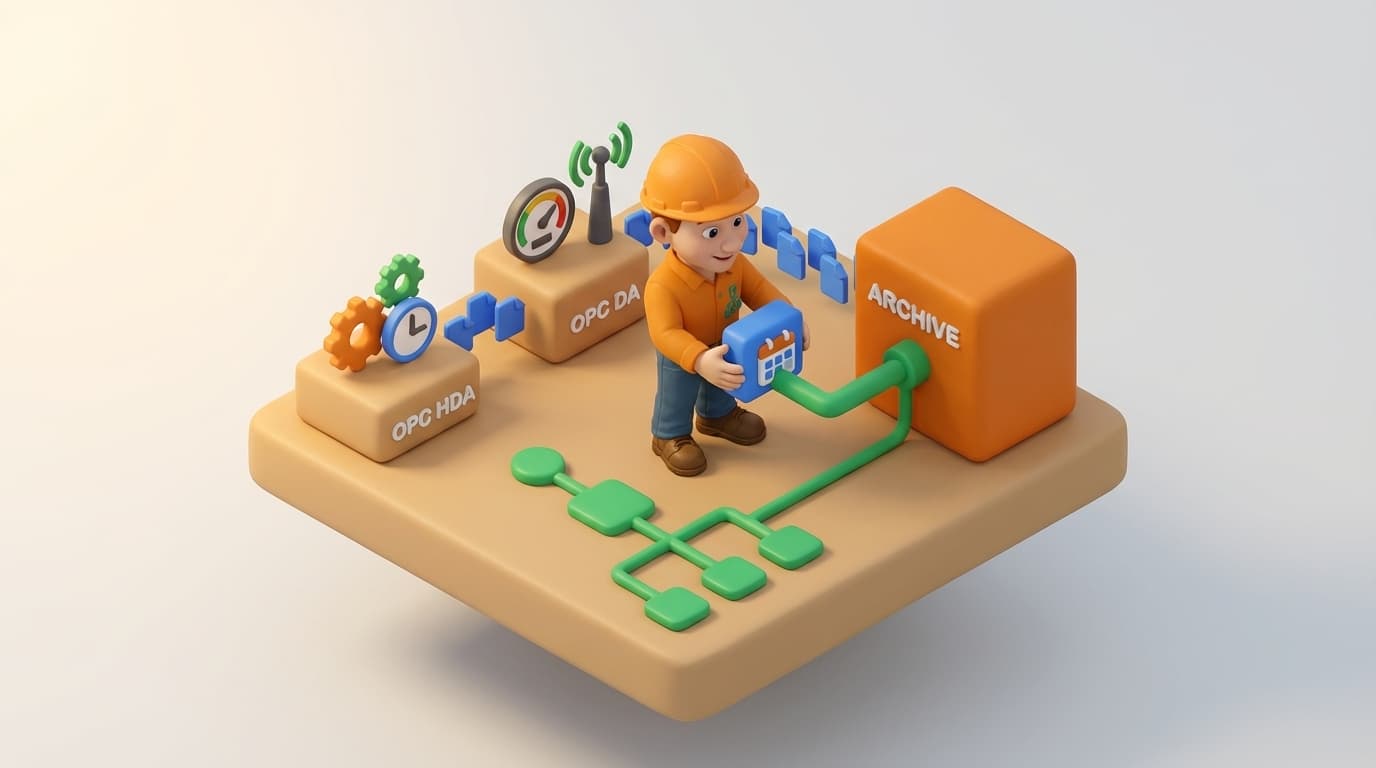
In situations where data is collected in real-time from an OPC DA server, a corresponding PI Point is configured to store this continuous stream. However, there are scenarios, particularly during complete network outages, where only historical data from SCADA systems - which don’t immediately align with the real-time data - is available through OPC HDA. This necessitates having two separate PI Points initially, one for real-time data (OPC DA) and another for historical data (OPC HDA), due to differing ItemIDs.

The Key Challenge

The primary challenge faced in such scenarios is efficiently merging or backfilling the historical data collected in the OPC HDA PI Point into the existing DA PI Point. This becomes cumbersome especially when dealing with a large scale, involving potentially 2000-3000 PI Point pairs.

Solutions for Backfilling Data

  1. Using AF SDK: For those with programming skills, AF SDK (Application Framework Software Development Kit) offers a robust solution to automate data transfer. This involves writing scripts or applications that can iterate over data point pairs and facilitate the transfer of historical data into the corresponding DA PI Point.

  2. Employing AF Analytics: AF Analytics provides a more visual approach, suitable for those who prefer minimal coding. By configuring recalculations within AF Analytics, users can efficiently map and transfer data from OPC HDA to OPC DA PI Points. While this may require some setup, it avoids coding altogether.

  3. Using PI-to-PI Interface: This approach is beneficial for automating data transfer across PI servers. Although primarily used for transferring data across different PI Data Archives, it can be configured to backfill historical data internally between PI Points under certain conditions.

Considerations

  • System Redundancy: It is vital to configure system redundancy and failover mechanisms at various levels, from OPC servers to PI Interfaces and PI Servers, ensuring uninterrupted data recording and availability.

  • Scalability and Maintenance: Any chosen solution should be scalable to handle large numbers of data point pairs and maintainability should be considered to make future updates and checks systematic.

Conclusion

While merging historical data from OPC HDA into OPC DA points initially appears complex, several strategies are available to simplify the task. Leveraging any of these methods can significantly enhance data continuity and ensure a comprehensive data set for analysis and reporting. For extensive implementations, understanding and utilizing tools like AF SDK or PI-to-PI Interface can save time and increase system reliability.

For further guidance, exploring OSIsoft’s extensive resources or connecting with experienced PI System professionals can provide invaluable insights.

Tags

#PI System
#AF SDK
#OPC DA
#OPC HDA
#Data Backfilling

About Roshan Soni

Expert in PI System implementation, industrial automation, and data management. Passionate about helping organizations maximize the value of their process data through innovative solutions and best practices.

Sign in to comment

Join the conversation by signing in to your account.

Comments (0)

No comments yet

Be the first to share your thoughts on this article.

Related Articles

Enhancing PI ProcessBook Trends with Banding and Zones: User Needs, Workarounds, and the Road Ahead

A look at the user demand for trend banding/zoning in OSIsoft PI ProcessBook, current VBA workarounds, UI challenges, and how future PI Vision releases aim to address these visualization needs.

Roshan Soni

Migrating PIAdvCalcFilVal Uptime Calculations from PI DataLink to PI OLEDB

Learn how to translate PI DataLink's PIAdvCalcFilVal advanced calculations—like counting uptime based on conditions—into efficient PI OLEDB SQL queries. Explore three practical approaches using PIAVG, PIINTERP, and PICOunt tables, and get tips for validation and accuracy.

Roshan Soni

Understanding PI Web API WebID Encoding: Can You Generate WebIDs Client-Side?

Curious about how PI Web API generates WebIDs and whether you can encode them client-side using GUIDs or paths? This article explores the encoding mechanisms, current documentation, and best practices for handling WebIDs in your applications.

Roshan Soni